
Share the moment
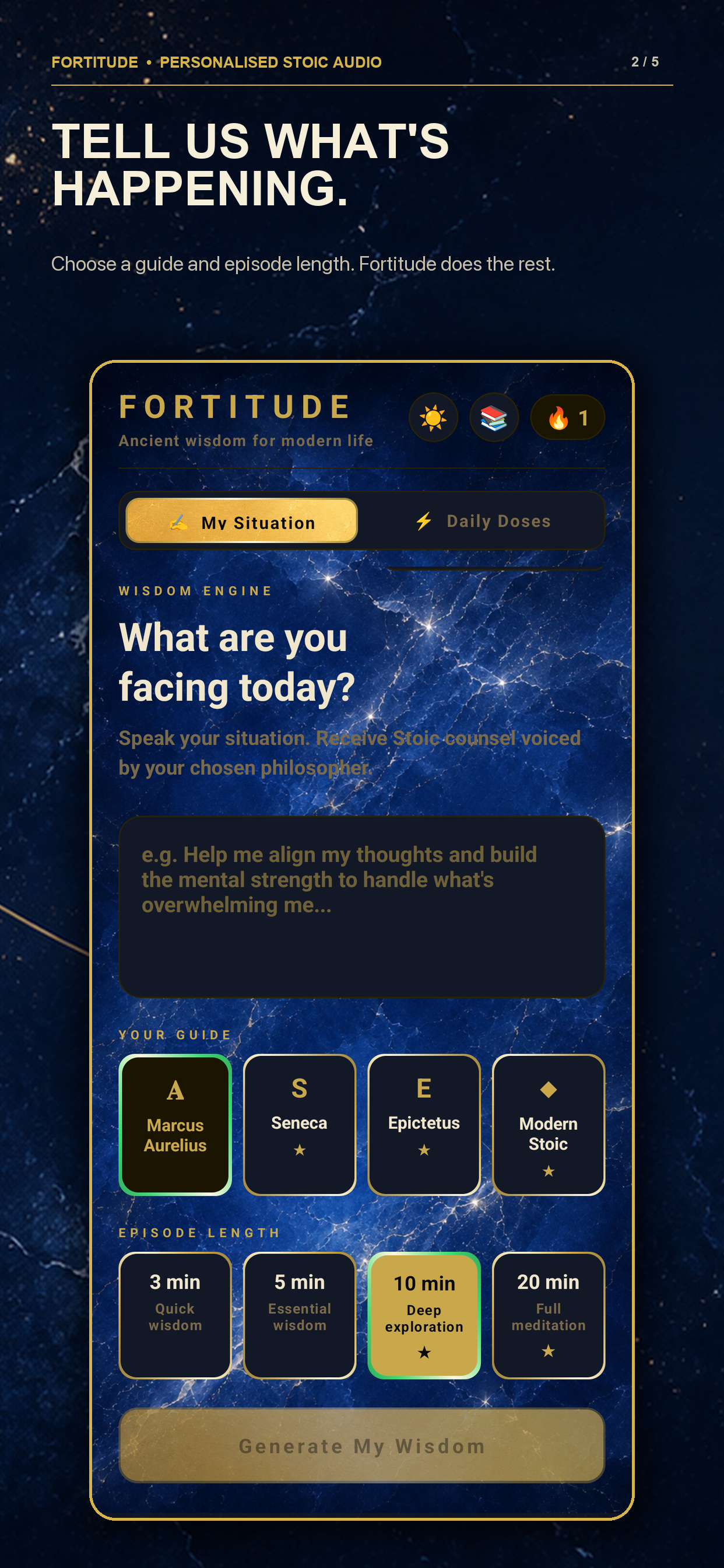
Write what is happening in your own words.
 FORTITUDEContact us
Personal Stoic wisdom · spoken for you
Tell Fortitude what you are facing. Choose Marcus Aurelius, Seneca, Epictetus or the Modern Stoic. Receive a voice wisdom episode written for your exact situation. You can listen wherever you want.
What is Fortitude?
You tell it what’s on your mind: a worry, a decision, a rough day. You pick a Stoic voice. Within minutes you get an audio episode, written for your situation and read aloud to you.
How it works
Write what is happening in your own words.
Select the perspective you want to hear.
Listen to wisdom created for this exact situation.
Fortitude does not hand everyone the same quotation. It starts with the real situation in front of you, then creates a focused spoken reflection for that moment.
Your council
Measured perspective for responsibility, pressure and the discipline of character.
Direct, practical counsel for fear, time, adversity and difficult choices.
Clear guidance on what is in your control—and what you can release.
Ancient principles translated for work, money, relationships and modern distraction.
Meet the Stoics
Roman emperor
Emperor of Rome from 161 to 180 AD and the last of the “Five Good Emperors”. He ruled through war on the northern frontier and a devastating plague, and wrote private notes to himself on how to stay fair, patient and steady under pressure. They survive as the Meditations, one of the most-read books in Stoicism.
In Fortitude: measured perspective on responsibility, pressure and character.
Statesman and writer
Born in Córdoba, in Roman Spain, Seneca became a playwright, a statesman and one of Rome’s wealthiest men, and for years advised the young emperor Nero. His essays and letters, including On the Shortness of Life and the Letters to Lucilius, are warm, practical and direct about fear, time and loss. He died in 65 AD after falling out with Nero.
In Fortitude: direct, practical counsel for fear, time, adversity and hard choices.
Former slave, teacher
Born into slavery in Phrygia, in today’s Turkey, Epictetus was later freed, studied Stoicism in Rome, and taught in Greece after the emperor Domitian banished philosophers from Rome. He wrote nothing himself. His student Arrian recorded his teaching in the Discourses and the short Handbook. His core idea: some things are up to us, and most are not.
In Fortitude: clear guidance on what is in your control, and what you can release.
The fourth voice, The Modern Stoic, is not a historical figure. It is Fortitude’s contemporary guide, translating Stoic ideas for work, money, relationships and modern distraction. Every episode is written by AI in the spirit of each thinker, not in their actual words.
See Fortitude in action
A simple flow built for the moment you need perspective—not another feed to scroll.
Use your own words and choose the episode length.
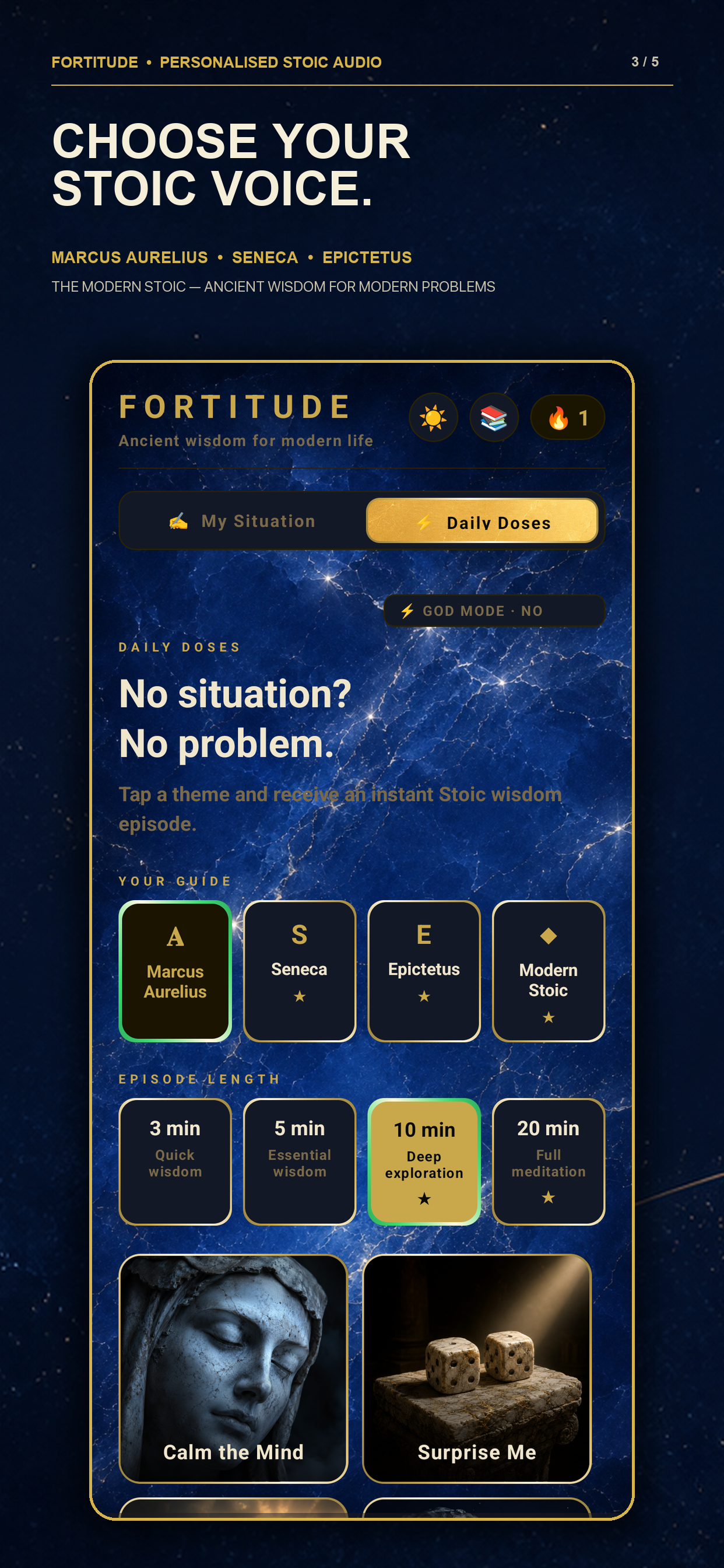
Marcus Aurelius, Seneca, Epictetus or the Modern Stoic.
Hear wisdom written and voiced for your exact situation.
The download buttons will activate as soon as the Apple and Google listings are live.
13-second product walkthrough · sound not required
Inside Fortitude
Choose a guide, describe what is happening, and listen when your personal episode is ready.
Questions about the app? ↓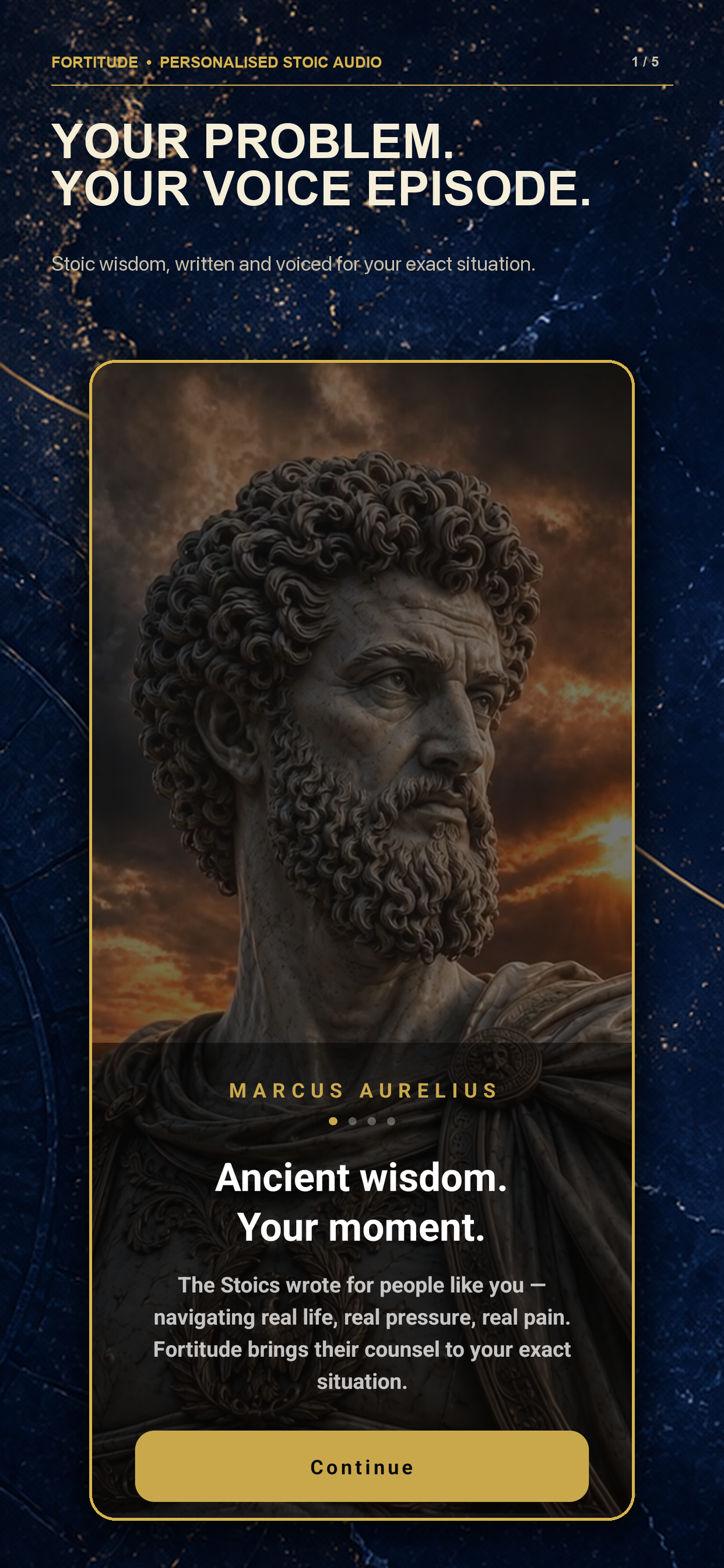
Stoicism, explained
A philosophy more than 2,300 years old, for staying steady when life isn’t.
Stoicism is an ancient Greek and Roman philosophy about how to live well when life is hard. Its big idea is simple: you can’t control what happens to you, but you can control how you respond. Stoics trained themselves to focus on their own choices and character, and to meet setbacks with clear thinking instead of panic or anger. It is less a theory than a daily practice.
Stoics believed that character matters most, and that a good life comes from practising four virtues:
A few Stoic habits put those virtues to work:
People who practise Stoicism often describe:
Stoicism is a practice, not a cure, and not a replacement for professional help. If you are struggling, please talk to a doctor or a mental health professional.
Common questions
Straight answers, no jargon.
No. Stoicism is a philosophy and a set of everyday practices. People of any faith, or none, use it. You don’t have to believe anything in particular to try it.
No. That’s a common mix-up with the everyday word “stoic”. The ancient Stoics didn’t aim to feel nothing. They aimed not to be ruled by destructive emotions such as rage and panic, while valuing things like love, joy and goodwill.
Zeno of Citium founded the school around 300 BC. The best-known later Stoics are the Romans Seneca, Epictetus and Marcus Aurelius, whose writing survives today. Fortitude’s first three voices are based on them.
Start small. Each morning, ask “What is up to me today?” Each evening, look back on what went well and what you would do differently. Read a little of Marcus Aurelius’s Meditations, Epictetus’s Handbook or Seneca’s letters. Or tell Fortitude what is on your mind and listen to an episode.
No. Marcus Aurelius, Seneca and Epictetus lived nearly two thousand years ago. Fortitude’s AI writes each episode in the spirit of their ideas, for your situation, and a text-to-speech voice reads it aloud.
No. Fortitude offers philosophy for reflection. It is not therapy, and it is not medical, psychological, legal or financial advice. If you are in crisis, please contact your local emergency services or a crisis line.
Support
For account access, subscriptions, playback, saved episodes, privacy or anything else, email us. We aim to make every request straightforward.
If your email app doesn’t open, copy the address and write to us from any email.
In Fortitude, open Journey → Account → Delete Account. This permanently removes your account and associated saved data.
Subscriptions are managed through your Apple App Store or Google Play account. Open your device subscription settings to change or cancel a plan.
No. Fortitude provides philosophical content for reflection and entertainment. It is not medical, psychological, legal or financial advice.
Fortitude is intended for people aged 17 and older.
Account deletion
You stay in control of your account and saved wisdom.
Open Fortitude, go to Journey → Account → Delete Account, then confirm Delete. This action cannot be undone.
If you cannot access the app, email hello@fortitudestoic.com from the address linked to your account and request account deletion.
Your sign-in account, email address, usage data, and all saved episode text and audio are permanently deleted. To stop the free trial being restarted by deleting an account and signing up again, we keep only a one-way hash of your email address (it cannot be turned back into your email) and the date it was first seen. You can ask us to remove that too.
Deleting your Fortitude account does not automatically cancel an Apple or Google subscription. Cancel any active subscription separately in your device's App Store or Google Play subscription settings.
Privacy policy
Last updated 1 November 2026
Fortitude is operated by Atlas Technology and Digital Services Pty Ltd, an Australian company.
When you sign in, your chosen sign-in provider may supply your name, email address and user ID. We also collect usage information such as episodes generated and minutes listened, purchase history needed to manage access, plus the text and audio of episodes you choose to save.
The situation or problem you enter is used to generate your wisdom response. Fortitude does not save that original prompt to its own database. Anthropic processes the prompt to create the response and may retain API inputs and outputs for up to 30 days under its standard service terms.
We use information only to operate Fortitude: creating personalized Stoic content, producing audio, maintaining your saved library, supporting your account and tracking subscription usage.
Fortitude uses Anthropic Claude for wisdom text, Google Cloud Text-to-Speech for audio, Supabase for secure account and episode storage, RevenueCat for subscription management, and Cloudflare Turnstile to protect sign-in from automated abuse (it processes limited browser and device signals). If you sign in with Google or Apple, that provider shares your email address with us. Each provider processes only what is needed for its service.
We do not sell or rent your personal information. We do not share it with third parties for their own advertising.
You can delete saved episodes individually or delete your account from Journey → Account → Delete Account. Account deletion permanently removes the associated account, usage and saved episode data.
To stop the free trial being restarted by deleting an account and signing up again with the same email, we keep a one-way hash of your email address (it cannot be turned back into your email) together with the date it was first seen. Nothing else is kept. If you want this removed too, email us at the address below.
Fortitude is intended for users aged 17 and older. We do not knowingly collect personal information from children under 13.
For privacy questions or requests, email hello@fortitudestoic.com.
Terms of use
Fortitude provides Stoic philosophy for entertainment and personal reflection. Its content is not professional medical, psychological, legal or financial advice.
You must be at least 17 years old to use Fortitude.
Paid plans and any free trial are billed through Apple or Google. Plans renew automatically unless cancelled through your store account before the renewal date.
You remain responsible for your decisions and for seeking qualified professional help where appropriate. Do not use the service for unlawful or abusive purposes.
We work to keep Fortitude available and accurate, but cannot guarantee uninterrupted operation or that generated content will suit every situation.
Questions about these terms can be sent to hello@fortitudestoic.com.